Tuesday, July 2, 2013

Fort William

As we left Skye we made one final stop at the northern end of the Cuillin Hills at a place called the Fairy Pools (not to be confused with the Fairy Glen).  Visitors to the pools can sometimes enjoy swimming in the blue-green water of the run-off from the hills.  The pools and associated falls extend for about 5 miles and include a lovely hike along the water to reach the favorite swimming hole that reportedly has an underwater arch to swim under and through.  Given the rainy, but thankfully not windy day we visited, we explored only about a 1/2 mile of the lower pools.  The water was incredibly cold but was remarkably clear and the falls were rushing madly, so much that I couldn't hear what Chris was saying only a few feet away.


Sofie and Noah at bottom of the Fairy Pools
From there we traveled along the scenic A87 to Fort William.  Along the way, our rental car sputtered to a stop along the motorway, in the rain, on a hill, on the left side of the road.  A Royal Air Force Mountain Rescue van pulled up as if summoned and kindly towed us a few miles to a safe pullout overlooking the beautiful Loch Lochy (Lake Lakey?) where we contacted Hertz by phone and they arranged for a local garage to pick us up.  (Thank goodness for audio books, as the wait was about an hour and 15 minutes.)   Our delay caused us to miss our appointment at the Ben Nevis High Wire Adventure Course but given the rainy conditions, it probably worked out for the best.

Along the scenic A87 to Fort William
Stranded above Loch Lochy

Panoramic view
We arrived in Fort William only a few hours later than anticipated with the car safely at a local garage.  It all in all worked out quite well, as the car wouldn't be ready until the following afternoon, and we were booked already on a day trip aboard the Jacobite Railway which would take us by steam train from Fort William along the coast to a quaint fishing village called Mallaig.   Having survived the car fiasco we now only had to face a raucous Scottish wedding at the hotel ...  The staff was very apologetic. ☺

The Jacobite Railway has been operating as a tour train since 1984 and the steam locomotive dates back to 1949, though the line itself is about 200 years old and was used as part of the land clearances that took Scots off their lands and dissolved the clan system.  The ride was peaceful and took us through some of Scotland's most beautiful scenery.  Many movies have been filmed in this area like "Local Hero" and in particular this was the part of the setting for the Harry Potter series, using the train as the Hogwarts Express.  We also traveled over the Glenfinnan viaduct which can be seen in the HP films, as well as the island that became Dumbledorf's final resting place.  The town of Mallaig was small, quaint and the lobster was excellent.

Playing the Viking Game aboard the Jacobite Railway.

The Jacobite steam train making its way over the Glenfinnan viaduct.
 (Picture taken with my phone from the open window which was too small
to get my Nikon through.)
Sofie and Noah in front of the steam engine in the rain
Mallaig Harbour
Upon return, the car was good to go, and we headed south to more central Scotland which would take us to the bonnie, bonnie banks of Loch Lomond.  Again, the drive was ridiculously beautiful, and although the rain prevented us from stopping often, we were able to take in the endless stretches of greenery which climbed to rocky, scarred crags high above the mist.

St Johns Episcopal, Ballachulish, Argyll

Celtic crosses overlooking Loch Leven
Beautiful Glencoe hills and waterfall
Chris and the kids in the "mizzle"  (mist and drizzle)

The Isle of Skye

Most visitors to Scotland head to the Isle of Skye from Edinburgh to take in the dramatic coastline and unique rock formations Skye has to offer.  We entered Skye from the southeast after leaving Scrabster and traveling through Strathpeffer, Dingwall and across the Skye bridge which was built in 1995.  Prior to that, visitors were required to take a ferry to this and other islands that make up the Inner Hebrides.  Skye has been inhabited for 9,000 years and settlements of Pict populations in pre-Christian times have been found throughout the island.  St. Columba (the same chap who documented the fist sighting of Nessie in Loch Ness) Christianized the island in the 6th century.  The Vikings controlled it from the 9th to the 13th century and the clan system took over thereafter.  Skye has one of the greatest concentrations of Gaelic speakers with 1/3 of its population claiming it as their primary language.  All signage on Skye lists Gaelic first and English second.  There are numerous tourist attractions on Skye in the form of historic places but the main reason visitors flock to Skye is for the natural beauty of the island.  Namely, the Old Man of Storr, the Quiraing, the Cuillin Hills, Fairy Glen and Fairy Pools, Kilt Rock, and Coral Beach.  We had been pretty lucky up until Skye as far as the weather goes, but hit some serious wind and rain which prevented us from seeing all of the hot (or should I say "cold and damp") spots for a few days.  We were based in the capital town of Portree which has a lovely harbor and numerous seafood restaurants and more B&Bs than sheep (and that is saying a lot here in Scotland) but not a tennis court to be found.

Portree Harbour
Portree Harbour seen through a window at the Harbour View restaurant
Our first stop was Eilean Donan Castle which sits proudly in the middle of Loch Duich along the A87 just before arriving in Skye.   The castle dates back to the 13th century and was intended to prevent Viking invaders from entering from the loch.  It is incredibly picturesque and one of the castles I most wanted to see on this trip.  You may recognize it from the Patrick Dempsey film "Made of Honor", the James Bond film "The World is Not Enough" or the Highlander TV series.  As you can imagine, it is also a very popular site for weddings.  Sadly, we arrived at the castle as it was closing (because we discovered Strathpeffer along the way and lingered ...) and were not able to spend as much time as we wished exploring the castle and grounds.  We planned to stop again on our way back, but hit bad weather and were not able to.  Next time, aye?

Eilean Donan at low tide
The entrance to the castle
Looking back at the top of the Achmore hill above Stromeferry
 looking east along Lochcarron towards Strathcarron.
Our next stop was Dunvegan Castle where we not only enjoyed the castle and gardens, but also a lovely boat trip looking for seals.  We were fortunate enough to see nearly 50 seals before it began to rain again.  Dunvegan Castle is the oldest continuously inhabited castle in Scotland and has been the ancestral home of the Chiefs of Clan Macleod for 800 years.  The Macleods themselves took us out a-sealing and entertained us with stories and accounts of local history.

Dunvegan Castle reflection
Dunvegan seal pup

Dunvegan seals
Dunvegan seal
After Dunvegan we hiked to Coral Beach on the northern tip of the island just as the weather was beginning to clear.  The beach is not coral but is actually ancient calcified seaweed and was an amazingly beautiful and serene place to spend a few hours.  The kids enjoyed finding tiny, near perfect, colorful seashells.  I have been a collector of sea glass for many years, and Sofie found me a lovely Scottish piece to add to my collection.

Coral Beach bounty
Coral Beach
Obnoxious Americans blocking the beach view
The walk back
After a nice lunch of cream of parsnip soup, arugula salad and sticky toffee pudding, we ventured east to the enchanted area known as Fairy Glen.  This is an unusual area of stunning rock formations and valleys covered in a carpet of shockingly green grass kept mowed by local sheep.  The area has a mystical quality to it and it is easy to imagine little fairies or wisps choosing to call this place home. All in all a fantastic and memorable day.
The kids atop the Fairy Castle


Fairy Glen rolling hills
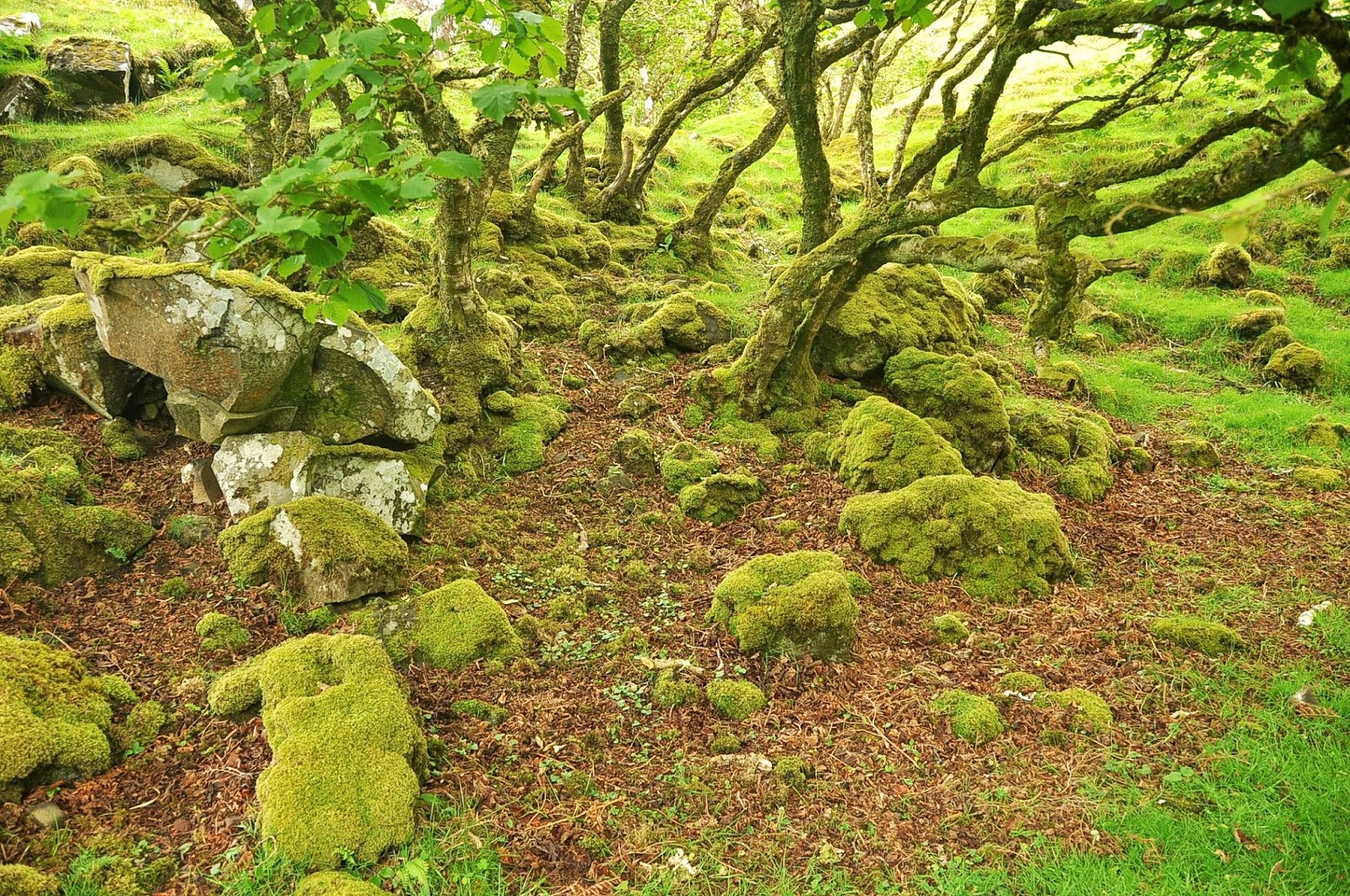
Mosses of Fairy Glen

View of Uig Bay (I think ...?) as we left the Fairy Glen
The next morning we were greeted by what we've heard can be a typical day on Skye - wind, rain and fog.  This limited us to sightseeing either from the car or by a short walk, but fortunately the roads were very accommodating to get us close to areas of beauty, and at times the fog lifted enough for us to see what we were seeking.  The wind was so extreme that we chose not to hike to the main attractions in the Quiraing, which we have been told are breathtaking, and the rain and fog prevented us from our planned scenic drive along the Trotternish Peninsula.  But, the Portree High School had just begun its summer programming and offered us the chance for some indoor badminton, which we took with alacrity.

Walking through the wind
Huddling against the winds whipping through the Quiraing
Road winding through the Quiraing
Kilt Rock and Mealt Falls
Badminton at Portree High School
As the day went on the weather improved and allowed for a view of the setting sun as we returned to our B&B.  We also got a chance to peak at our elusive friends the Heilan' Coos (Highland cows).

Sun setting over Grasmhor B&B
Skye coos

From Skye we head to Fort William and Glencoe to challenge ourselves at the Ben Nevis High Wire Adventure and take the Jacobite Railway along the scenic western coast.

Thursday, June 27, 2013

The Orkney Islands

Reaching the northern most tip of mainland Scotland (Scrabster), we boarded the HM Hamnavoe for an hour and one half trip across the North Sea to the Orkney Islands.  The Orkneys are a cluster of 70 islands (20 of which are inhabited) that were apparently acquired from Norway in an obscure marriage dowry in 1468.    Along the way, the dramatic coastline of Hoy greets visitors travelling to Orkney by ferry from the Scottish mainland.  We stayed on the mainland of Orkney in the capital of Kirkwall, and it became clear to us after not much time on the island that there was a much stronger Scandinavian than Scottish influence here (and it wasn't only due to the presence of the Norwegian flag every 500 yards or so ...).   Along with differences in building construction , the native Orcadians seemed to be physically smaller than mainland Scots and this was confirmed by locals who told us that the average height for a male on Orkney is 5'7".

Orkney is most well known for its Neolithic sites including the 5,000 year old settlement of Skara Brae on the mainland that was found almost entirely intact.  The settlement was unearthed almost 100 years ago by a huge windstorm which revealed multiple dwellings with many rooms still full of stone furniture, fire pits, hunting and cooking implements and jewelry. 

Skara Brae underground dwelling
Fulmars of Skara Brae
Close by is Maes Howe which is a massive tomb that predates the oldest pyramids in Egypt.  More recently the tomb was used by Viking travelers about 1,000 years ago and is filled with their Runic writings and a detailed and very small carving of a dragon/wolf/sheep (?).  This tomb, like the Clava Cairns we saw earlier, also has a doorway that lines up perfectly with the winter solstice sun, which seems to imply that a similar culture inhabited this entire area.

Chris emerging from Maes Howe.  Photos of the entrance were the only ones allowed.

Associated with these sites are two massively impressive standing stones circles.  The first is the Standing Stones of Stenness, (really best said as Sylvester the Cat or Sid the Sloth, depending on your generation) and the other is the Ring of Brodgar.   It was an impressive and awe-inspiring place as some of these stones are 15 feet high, and are again arranged to line up with the movements of the sun during the year.  When planning our trip we knew we wouldn't be able to include a trip to the Outer Hebrides and the Calanish Standing Stones, the disappointment of that was quickly dispelled by the magnificence of the Ring Of Brodgar.

The Ring of Brodgar originally housed 60 stones of which 34 remain
Brodgar posers

Worthy of mention is that the weather on Orkney was, in a word:  brutal.  You won't find colorfully painted cottages or much individuality expressed through yard art or fixtures here.  All buildings look pretty much the same and are covered by a gravelly substance over stucco that must protect surfaces from the lashing sea water and wind.  But what may be lost in curb appeal, can definitely be found in the natural landscape and beauty of Orkney.  We were fortunate in that we only had one day with gale force winds, but were able to get out and about otherwise, which is lucky because other than the church of St. Magnus, the Earl's Palace (a ruin) and a whisky distillery, there were not many "indoor" activities available on the island.  And, although there was only one hour of darkness each night, nearly every shop closed at 4pm, leaving the streets empty and the town quiet.  Many Orcadians dine out in the 2 available hotel restaurants in Kirkwall, so make your lunch and dinner reservations ahead of time or you will be out of luck!  Despite the rough weather conditions, the remoteness of the island  and the "other world" feeling of Kirkwall, Orkney is a beautiful, historically rich and extremely worthwhile destination.
The Earl's Palace
St. Magnus Cathedral and 1/3 of kirkyard
We had enough good weather to enjoy some of the natural beauty of the islands.  Just north of the stone age dwellings we stumbled across a hike which led us to within 15 feet of some cliff dwelling puffins.  These along with other seabirds were returning from a day of fishing and seemed to have little or no fear of us.  They were delightful and even cuter in person, if possible.

Sofie in the pink clover of Marwick Head
Marwick Head looking towards Hoy

The Clan Puffin of Marwick Head
Duncan of Clan Puffin
Many small islands make up the Orkneys and they all offer interesting historical sites, expansive shoreline, natural beauty, abundant wildlife and even a castle or two.  Ferries can transport you easily from one island to the next and much of the mainland is bikeable.  On our last day we went to the nearby island of Hoy where we hiked through the heather to the remote Old Man of Hoy, a sandstone sea stack tower just separated from the imposing sea cliffs.  We calculated the height by timing the fall of a rock and estimated it to be about 700 feet.  We thoroughly enjoyed relaxing in the surprisingly comfortable spongy heather to partake in our lunch.   It was a beautiful day with frequent bursts of sunshine to warm us.  We were entertained by a small group of rock climbers attempting to reach the top of the Old Man while seagulls and other birds circled them in the air.

Lunching in the comfy heather
Hoy posers

Chris and the kids are off to the right
The Old Man
The walk back
Old Man of Hoy panorama taken with my iPhone
On our way back to the car we walked through the old crofting township of Rackwick which is said to be one of the oldest in Scotland.  It is an isolated valley where original old crofting huts still exist and the villagers live a traditional crofting life without many modern conveniences.  An unusual rock-cut tomb, the Dwarfie Stane, lies in the Rackwick valley in the north of the island. It is unique in northern Europe, bearing similarity to Neolithic or Bronze Age tombs around the Mediterranean. The tomb gets its name as it is very small and was said to be carved by dwarves.

Dwarfie Stane
On the ferry to Hoy
Rackwick Valley

We returned to the ferry terminal in Stromness to await boarding the ferry which would take us back to Scrabster on mainland Scotland.  We planned an overnight stay on the ferry in a cozy cabin that slept 4 to avoid an extremely early drive to the terminal in the morning.  Once in Scrabster we began the long drive to the Isle of Skye on the western coast of Scotland.

The HM Hamnavoe
Boarding the ferry
On the deck passing Hoy
Aboard the ferry
Our cabin aboard the ferry